Lore
The world of Steckfeld SF1
Where the SF1 comes from, the shop that sells it, the terminal that comes with it, and the crews who write modules for it without asking.
The years are 2026 to 2030. AI makes the music, the films, the pictures and the text, and it makes them for nothing. Whatever you can describe is a prompt away, in any style, as often as you like.
People got tired of that sooner than anyone expected. When a piece of music costs nothing to make, finishing one stops meaning much. So a market grew for the opposite: machines that do one job, that no model can reach into, and that you have to learn before they sound good. Their limits can't be prompted away. A filter has one cutoff knob and you turn it yourself.
These machines have a few things in common. You work them with knobs, keys and cables, never by touch. Their displays show what the circuit is doing at that moment, such as a waveform, a level or the state of a switch.
None of it is nostalgia. The displays are current OLEDs and LCDs and nothing is made to look old. There just isn't anything inside for a model to run on.
Steckfeld SF1
The SF1 is a modular synthesizer in one casing. Steckfeld means patch bay, and the bay takes up most of the front: four rows of twelve slots. A module is the size of an SD card, and you set it in with tweezers.
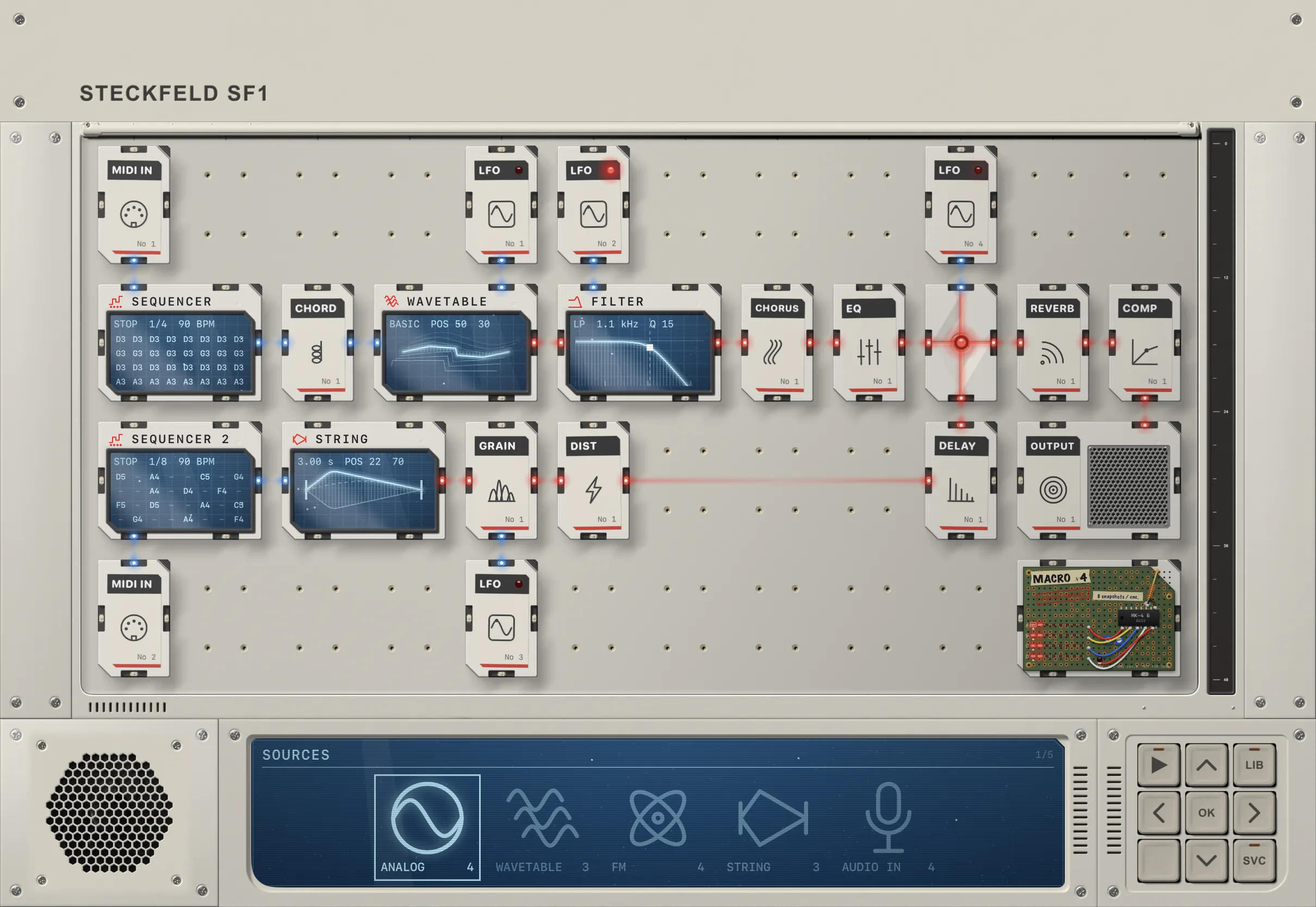
Modules that sit next to each other can be connected. A connection shows as a light between the two, red when it carries sound and blue when it carries control. Most modules have a small display that shows what they're doing. The wavetable draws its wave, the filter its curve, the sequencer its steps.
Below the bay there's a display for the parts and a keypad of nine keys, one of them blank. The SF1 has no keyboard. It plays from its own sequencers or from whatever MIDI keyboard you plug in.
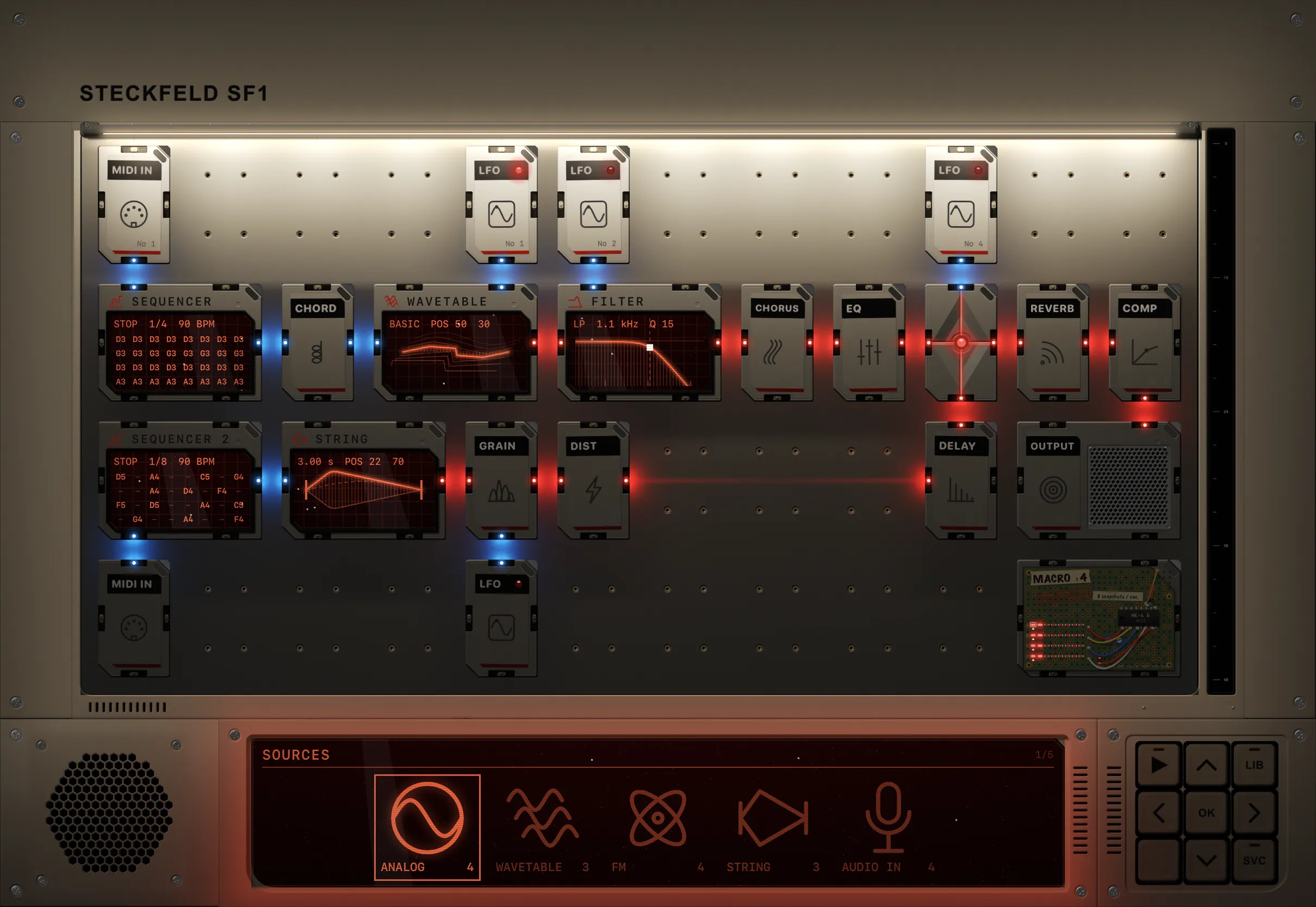
When the room goes dark, a strip lamp over the bay lights the modules and the displays turn from blue to red, the way instruments on a stage are dimmed so they don't dazzle.
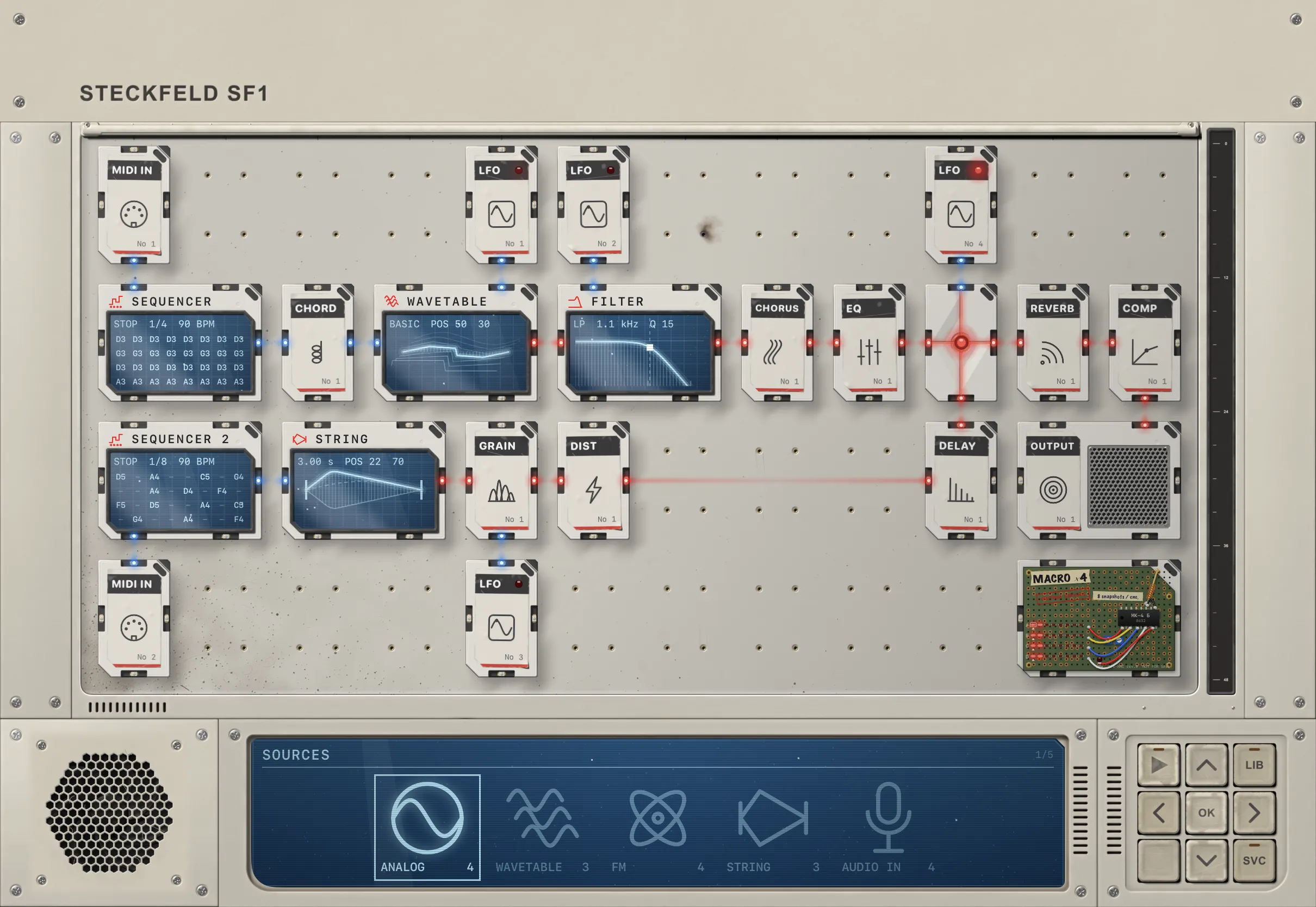
It comes sealed in a blister pack
A new SF1 comes in a clear blister pack with a price label on it, and it stays in the pack until it's paid for.
A hole is cut over the ▶ key, with a TRY ME! sticker next to it. Press it and the unit plays SLOW CURRENT, a slow pad with a plucked string over it. Everything else stays under the plastic.
When you buy it, you get a paper bill stamped BEZAHLT, and the pack comes off.
From then on the casing wears as you play: scratches first, then rust and rubbed keys.
The programmer
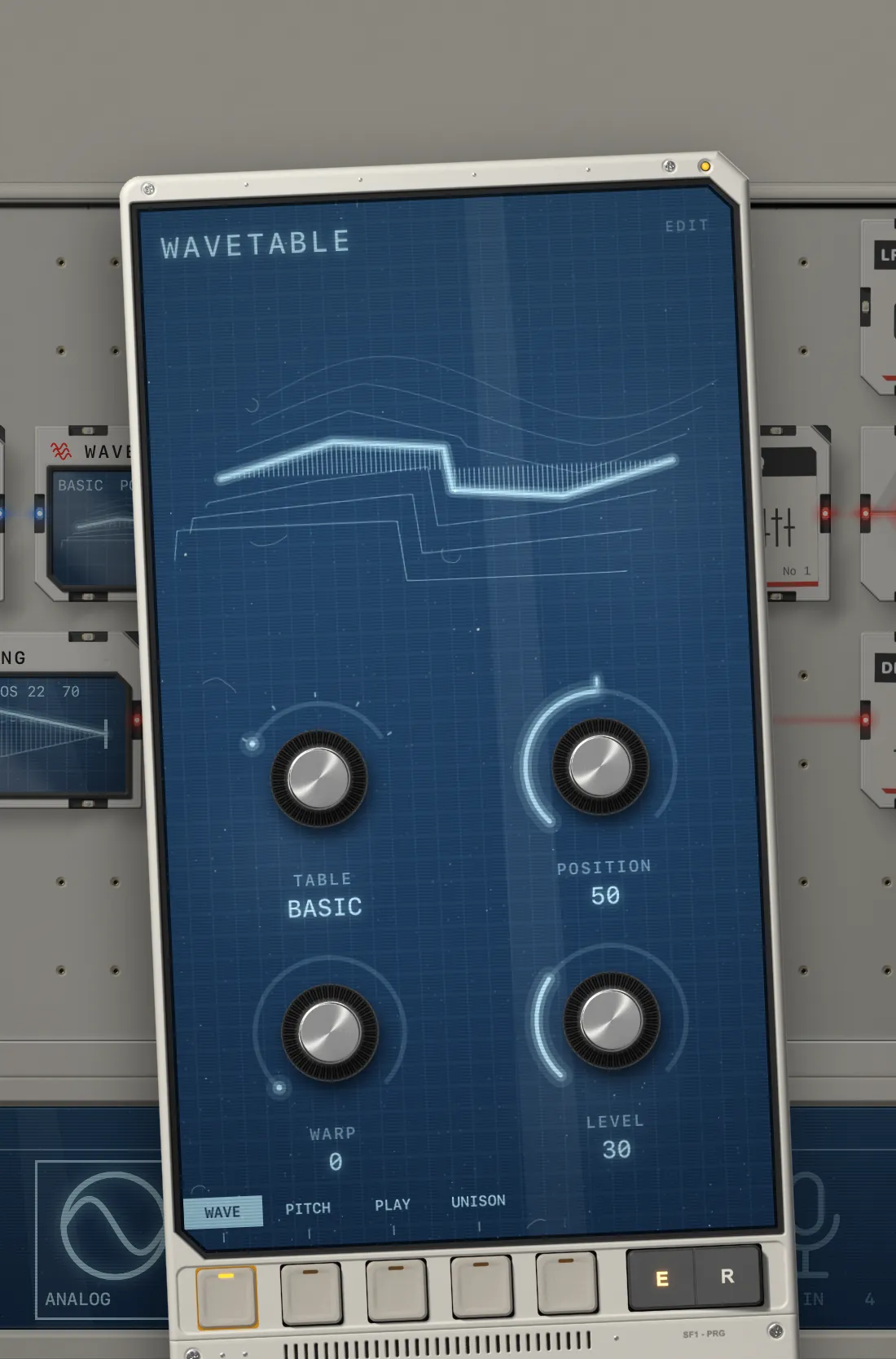
A module the size of an SD card has no room for knobs. To set one you use the programmer, a handheld that belongs to the SF1.
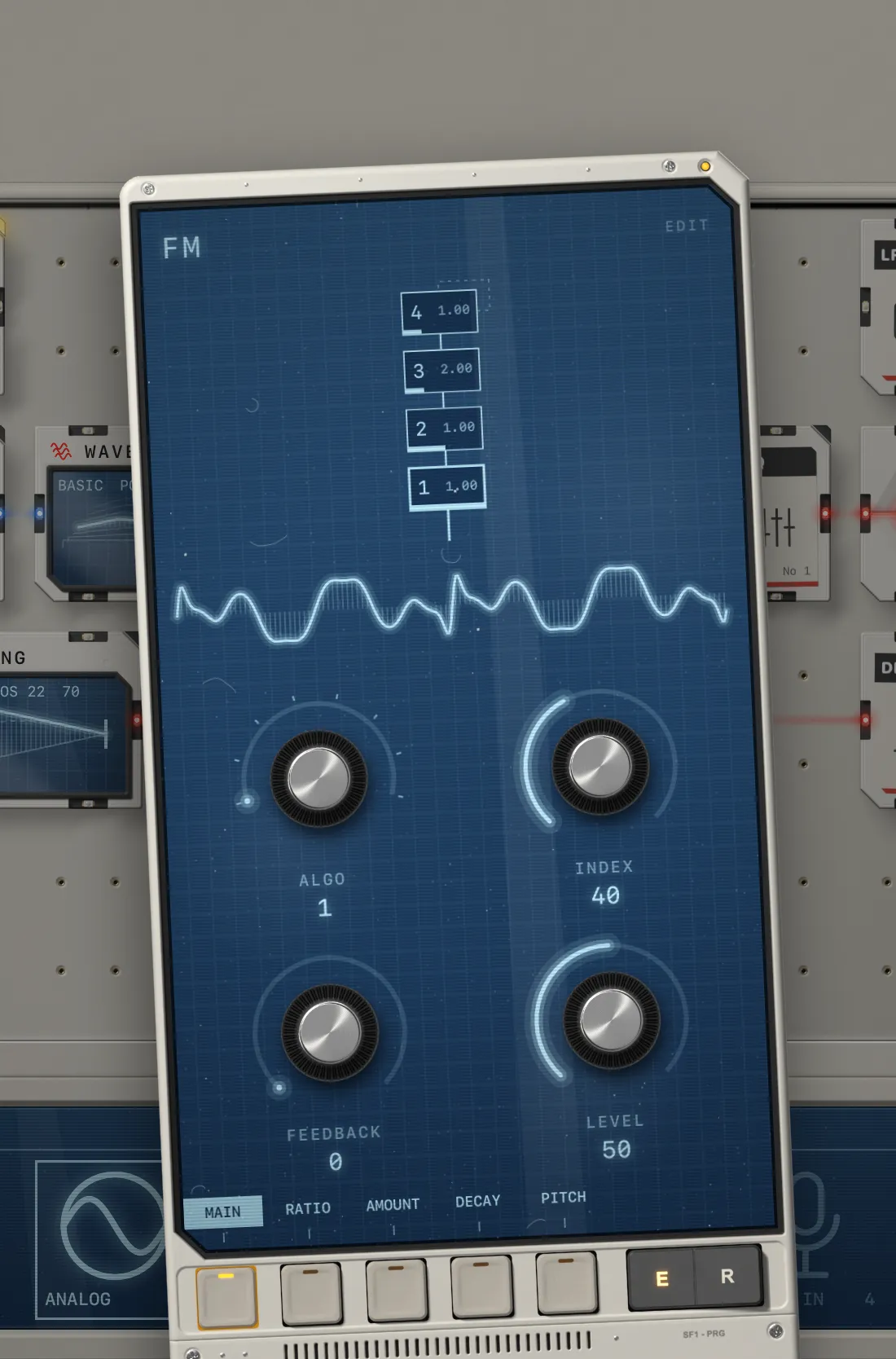
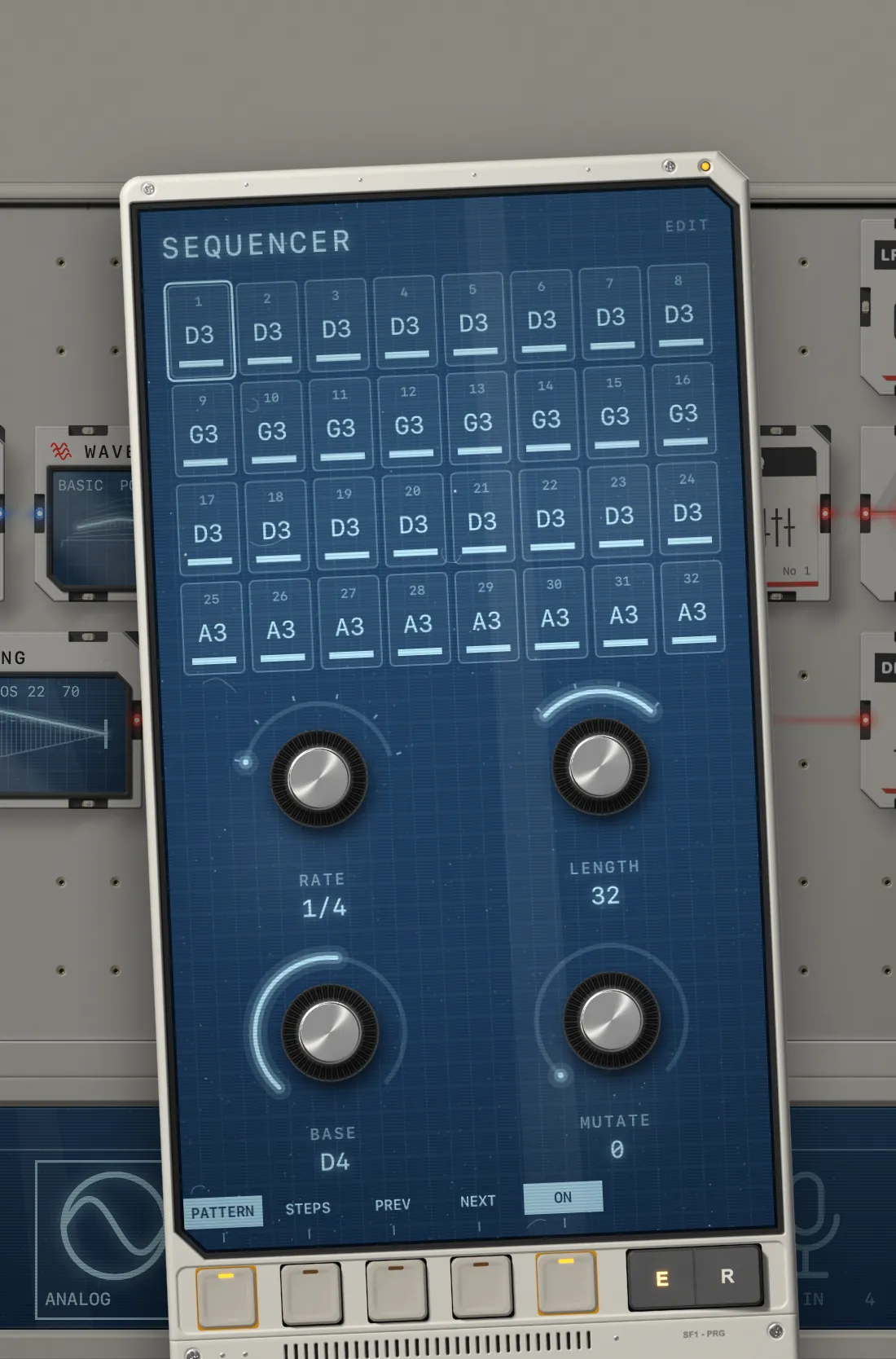
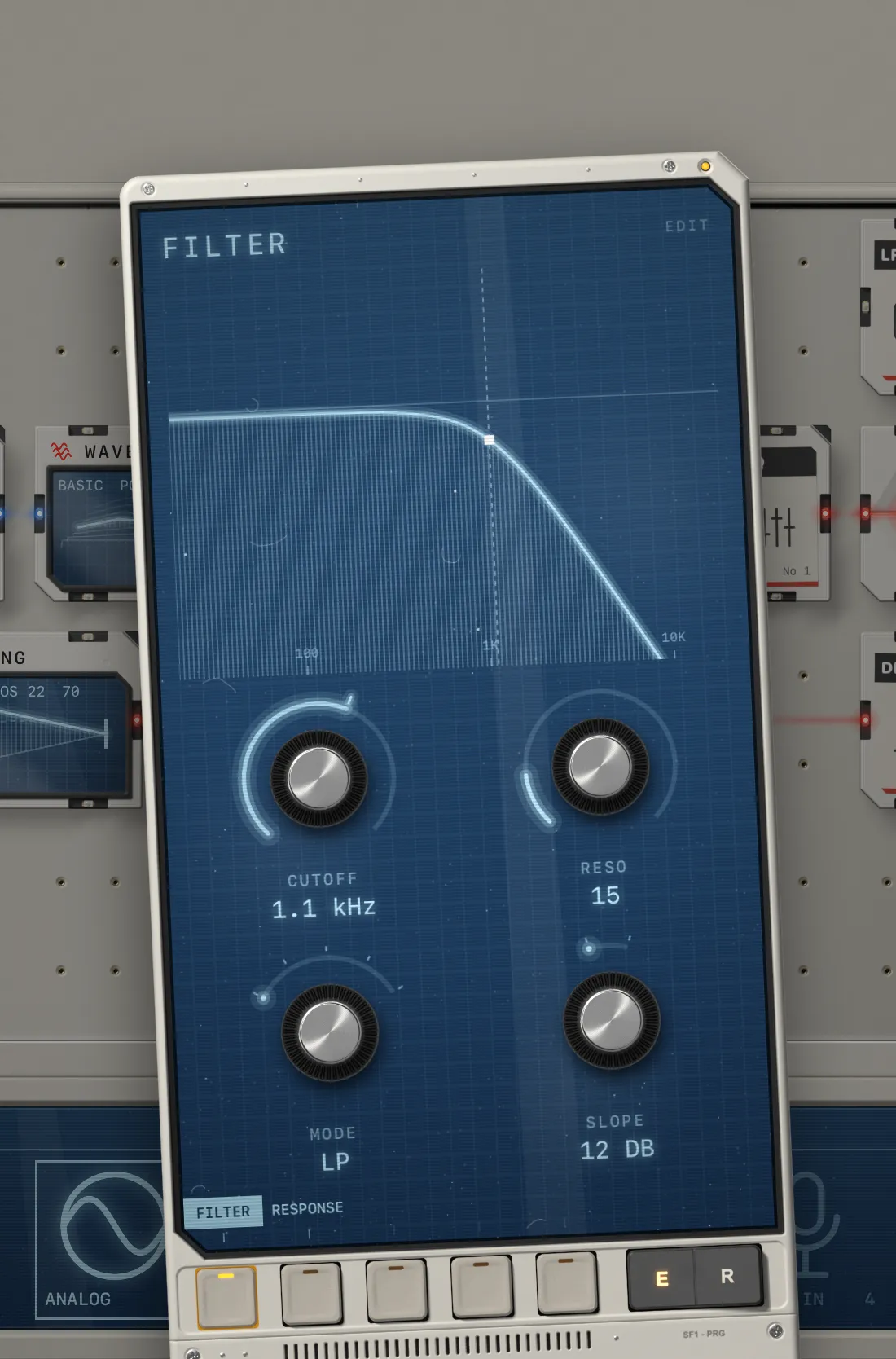
Its screen draws what a module does, at full size: the operators of the FM voice and the wave they add up to, the curve of the filter. Four knobs set it. Kabelmaier stocks spare knobs for it, a set of four in Bakelite.
Elektro Kabelmaier
Elektro Kabelmaier
Radio · TV · Elektro · Haushalt – Ihr Fachhändler seit 1974
You buy the SF1 at Elektro Kabelmaier in Passau, which has sold radios, televisions and household appliances since 1974. The same shop sells egg cookers, hair dryers and power strips. It's closed on Wednesday afternoons, takes cash or EC card, and still prices everything in D-Mark. Its website was built by the owner's nephew in 1998 and says it's under construction.
The owner, Horst, is an Elektroniker-Meister with more than a hundred master certificates. Years ago he cracked pay-TV receivers. He can build or repair anything with a circuit in it, and he has no sense for how a thing should look.
His shop is one of the few places AI can't get into. Nothing he sells talks back or updates itself, and that is why the SF1 is sold there.
He is looking for an apprentice.
Kabelmaier's terminal
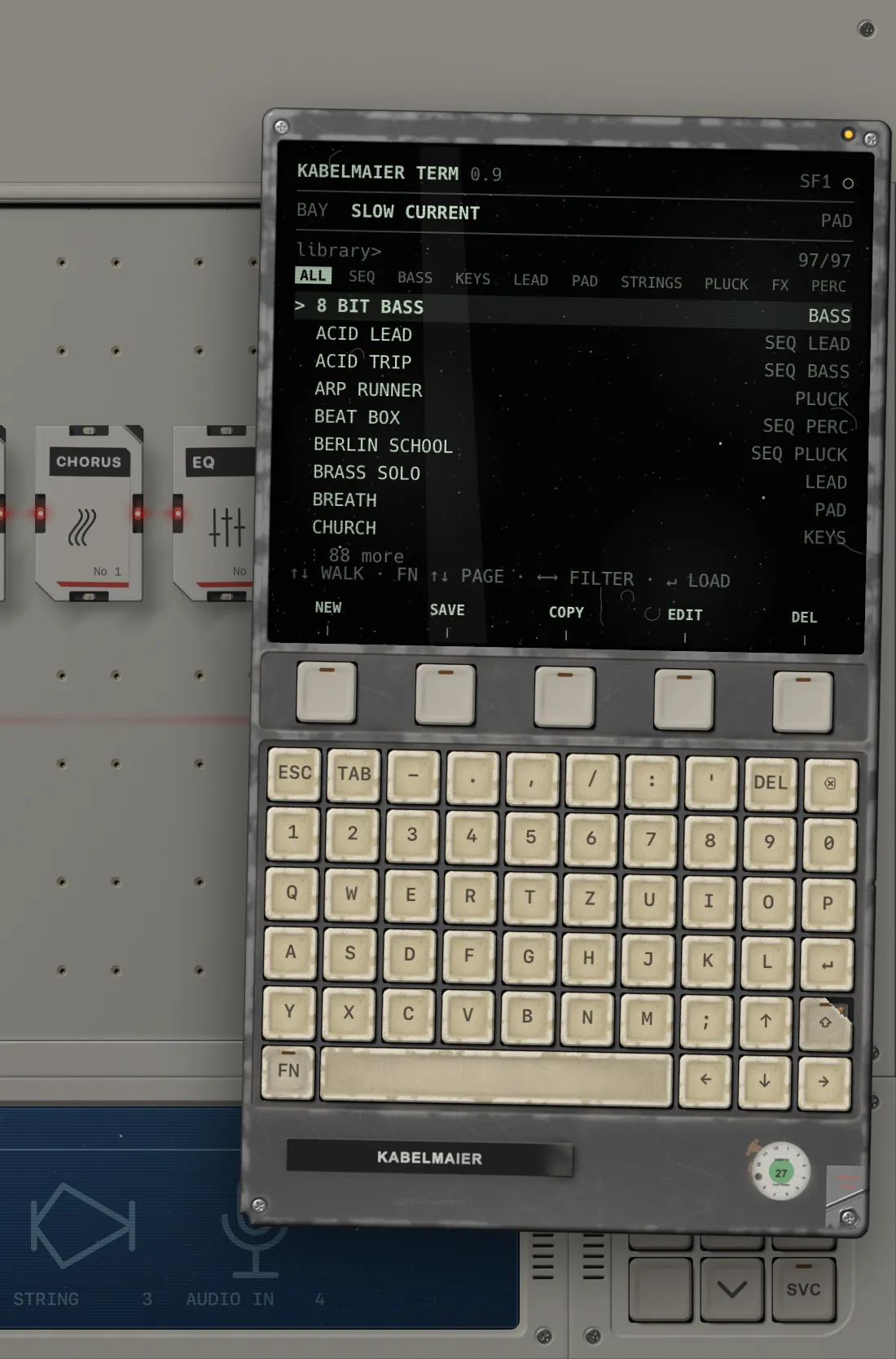
With every SF1, Horst hands over a terminal he makes himself. It's a graphite ABS box with a mono LCD, five soft keys under the screen and a keyboard of mechanical keys. A ribbon cable connects it to the SF1.
It keeps the patch library. It also has a modem, and a directory of phone numbers.
It was built by someone who only cares that it works. The keys are laid out the German way, with Z where an English keyboard has Y. The shift key is dead, so everything is in capitals, and a patch name holds 14 characters. Nothing on the screen reacts to touch.
Where the patches come from
A terminal comes with 97 patches filed on it. Steckfeld didn't write them, and neither did Horst, who doesn't play.
They're from customers. When someone brings an SF1 into the shop, he connects his own terminal, and if there's a patch in the bay he doesn't have, he asks whether he can keep a copy. The ones he likes go onto every terminal he hands out after that.
Yours are filed next to theirs, starting at USER 001.
KABELMAIER TERM 0.9SF1 ○
library>97/97
- > SUB PRESSUREBASS
- LADDER FATBASS
- TINE EPKEYS
- WURLYKEYS
- HYPERSAWLEAD
- FOLDBACKLEAD
- WARM ANALOGPAD
- SHIMMER HALLPAD
- STRING MACHINESTRINGS
- SECTION SWELLSTRINGS
- NYLONPLUCK
- STEEL STRINGPLUCK
- SPACE DRONEFX
- RISERFX
- KICK DRUMPERC
- SNAREPERC
: 81 more
16 BASS12 KEYS14 LEAD15 PAD8 STRINGS12 PLUCK11 FX9 PERC
MACRO
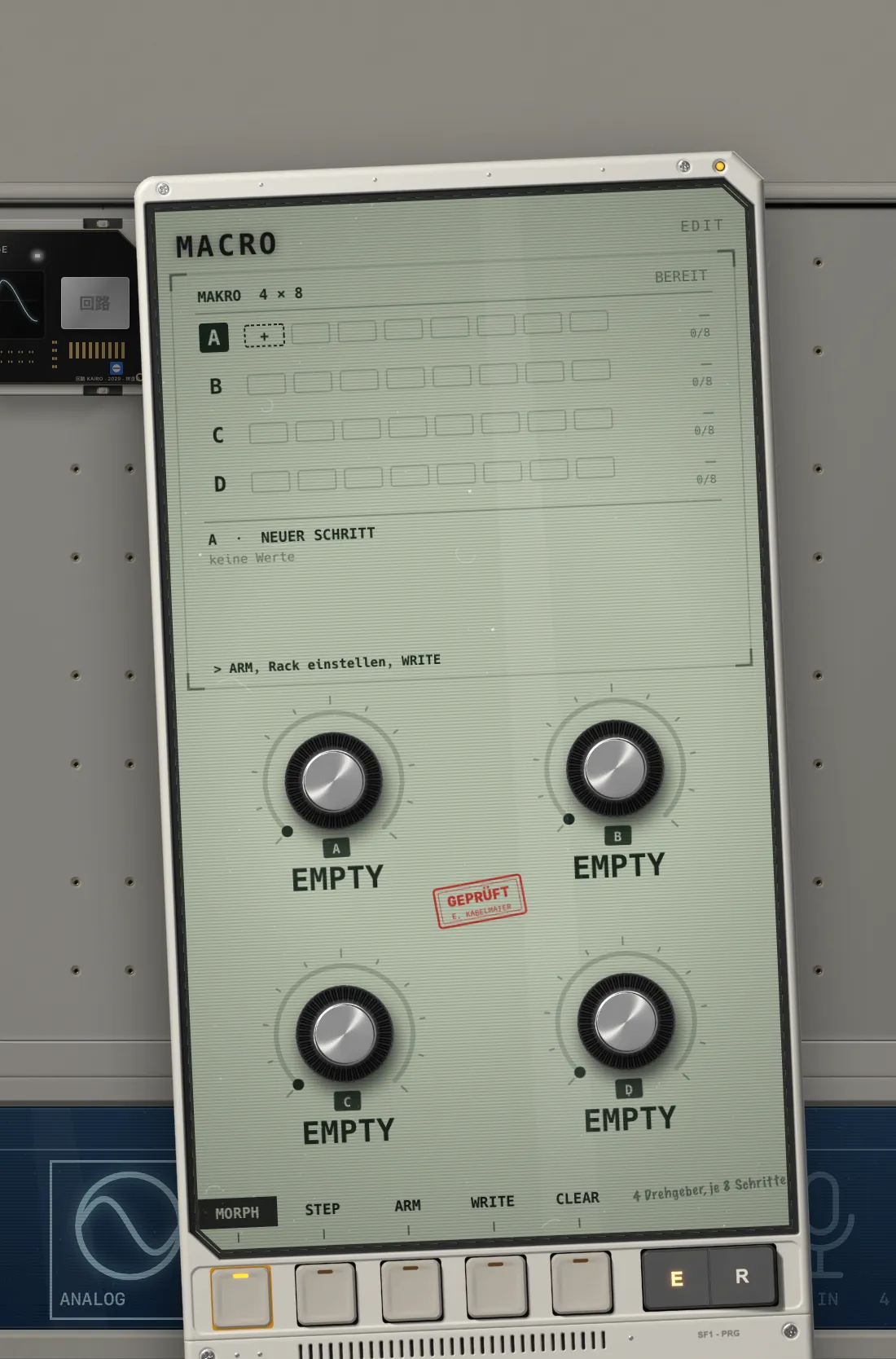
There is one module Horst built himself. MACRO has four master encoders that morph the whole rack between snapshots you've written.
It has no connections to the other modules. It reaches them over the air, through a whip antenna. Its screen is plain text, in German, and a log.
The board is built to VDE and comes from a Meisterbetrieb, and it looks like it. There's one in every SF1 he sells.
The world
Nobody can say exactly when it tipped. Generation got cheap, then it was everywhere, and within a few years nearly everything people saw, heard, bought and read had been made by a machine in a few seconds. Most of it was good enough. None of it came out the same twice, and very little of it lasted.
It didn't hit everyone the same way. Old firms that had spent centuries getting things right went under. The work disappeared, and with it the people who used to do it. The bins filled up, and a generation of kids lost their friends to the feeds.
Not everyone went along. Some kept making things the old way, and found each other through the few places that still sold the parts.
They also left the web, which by then was mostly machines writing for machines, and went back to the telephone. A crew puts a computer on a phone line, and whoever dials the number gets its board on the screen. At night the boards call each other and hand the mail on, so a message from Prague reaches Tokyo a couple of days later without ever touching the internet.
Sooner or later most of them order from an electrical shop in Passau, though hardly any of them has ever been there. Horst Kabelmaier sits on a pile of parts nobody else carries any more, most of it bought by the crate back when nobody wanted it, and he knows what to do with every one of them. For a lot of people he's the only place left to get either. He's old and tired and a little strange. He prices everything in D-Mark and will talk your ear off about the pay-TV receivers he used to crack. Unlike some in his trade, he doesn't decide who is worthy of buying. He loves what the crews are doing, passes on their messages and sends parts to anyone who asks properly. He's been looking for an apprentice for a long time. Nobody knows how much longer the shop will stay open, and after it there's nowhere else to go.
To get onto the boards you need a terminal, and Kabelmaier builds one. It's a general-purpose box for the old ways of connecting. It dials the boards and fetches the mail, and it can do a good deal more than that. The one in the SF1 is the same terminal with only Steckfeld's part switched on. Most of the mail between the boards passes through his shop.
The crews tease each other constantly. RASTER say ZKRAT's salvaged parts are out of tolerance, and ZKRAT say it's easy to be perfect on KAIRO's money. KAIRO find RASTER's drawings beautiful and joyless, and LIGNE call RASTER the grandfathers. RASTER's board still greets the other three by name.
The black market
Steckfeld makes the parts that come with the SF1. A handful of crews make others. Each one writes its own firmware, solders its own board, screws it onto a blank module body and puts the ROM on a dial-up board for anyone who has a terminal.
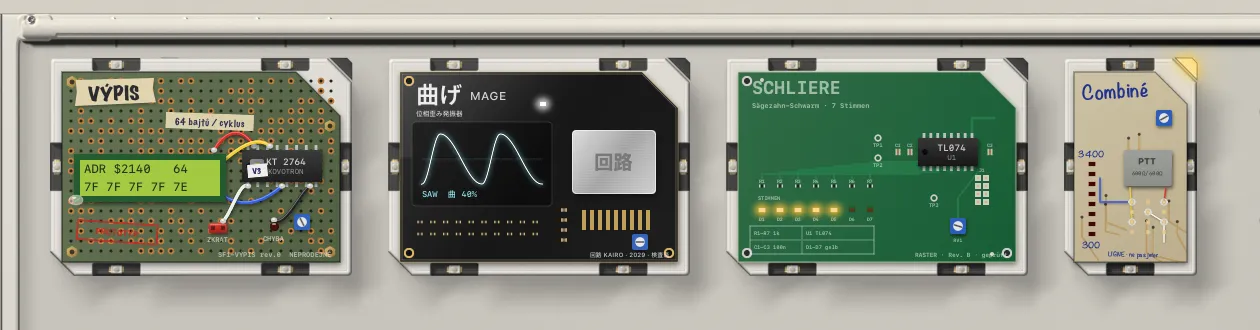
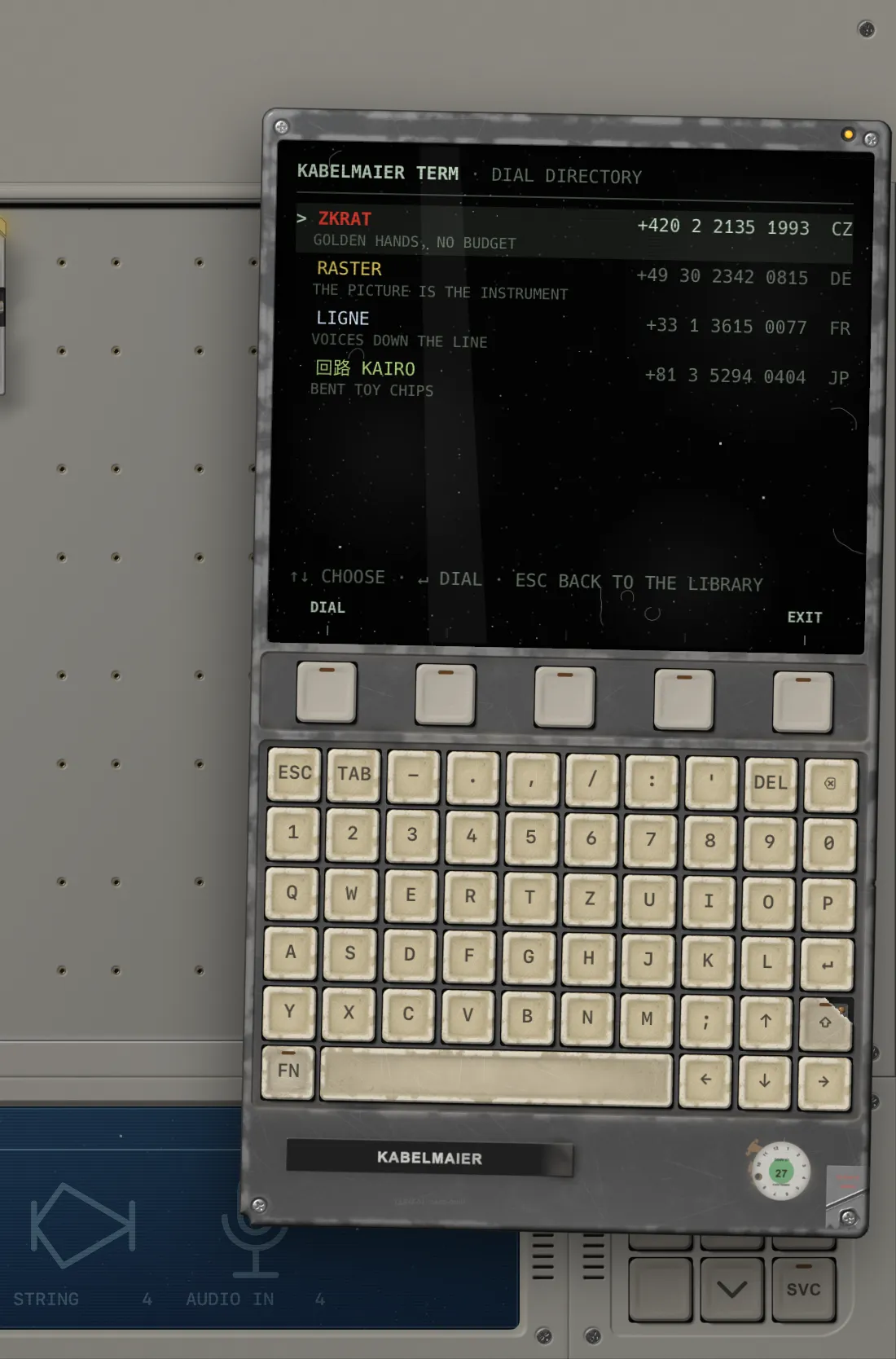
You dial them from the terminal. The board that answers is in the crew's language and the crew's style, and the modules are downloaded from there.
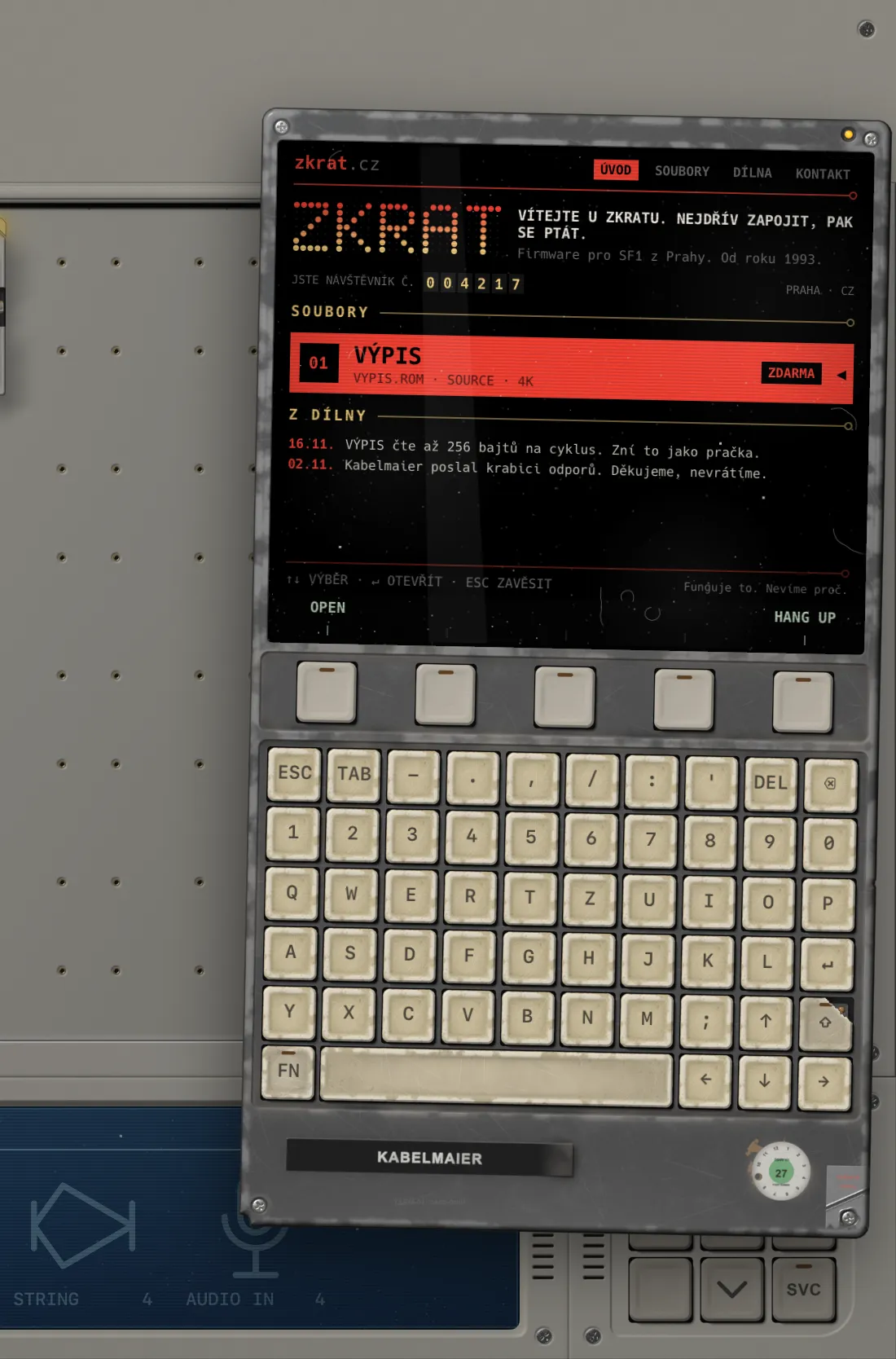
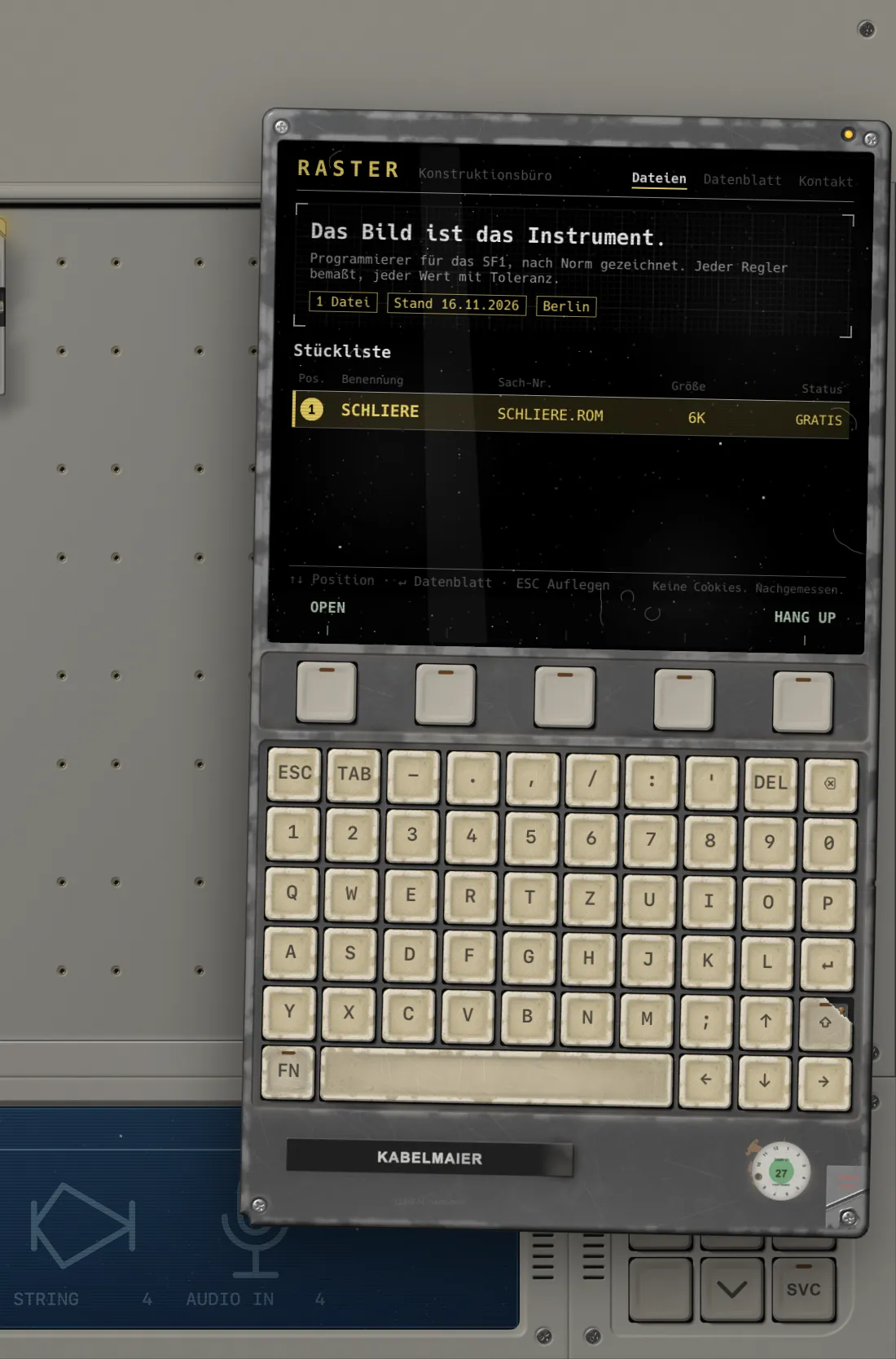
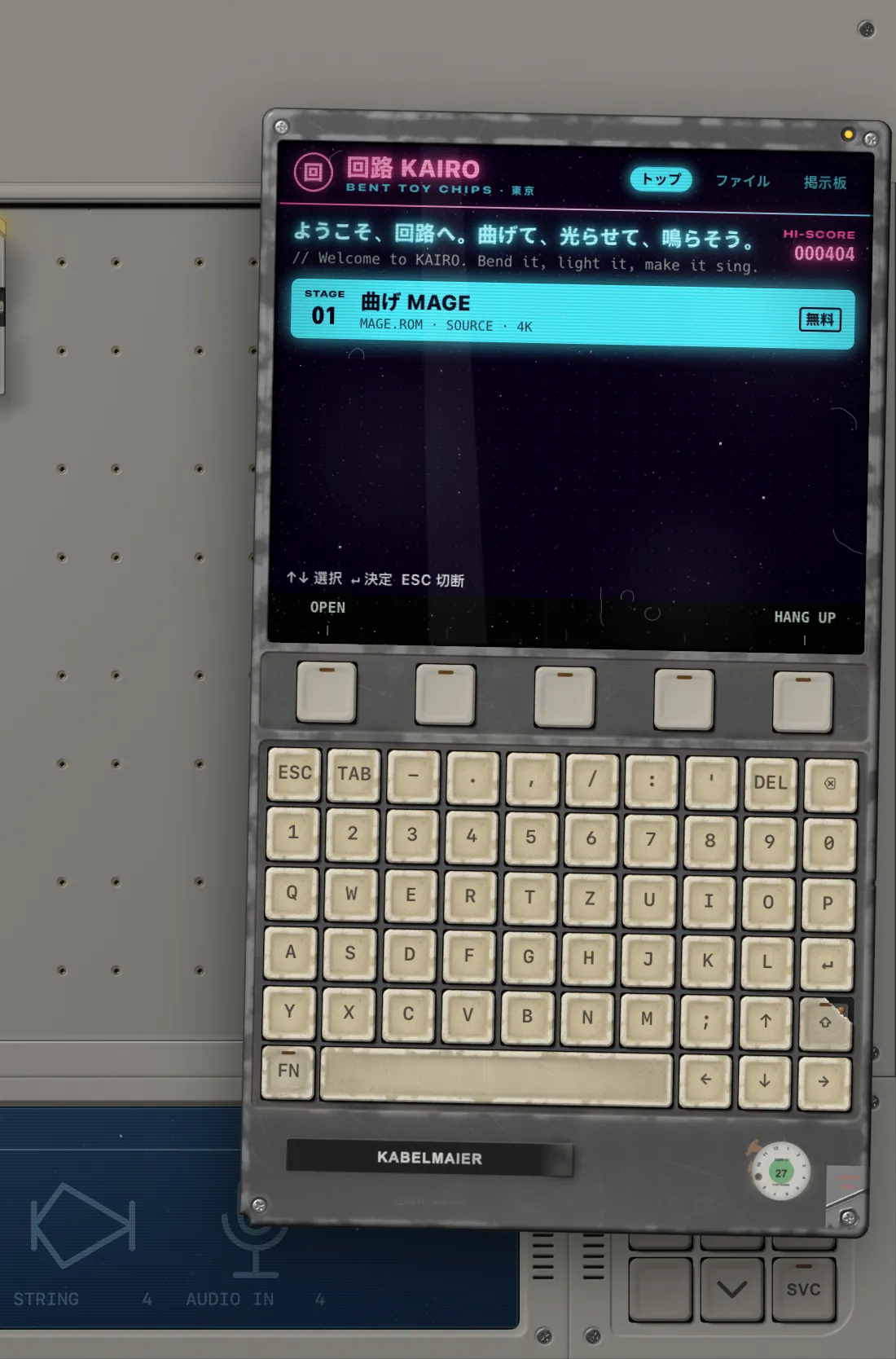
Some of them cost money, and you pay on the terminal. A crew with nothing on its board doesn't pick up.
On the programmer, a crew's module doesn't look like one of Steckfeld's. Each crew draws its screen as one picture, composed around the four knobs.
The crews know each other. RASTER's board greets the other three by name, and Kabelmaier with them. They also don't stay on their boards. Every few days one of them takes over a website, Steckfeld's or the shop's, and for some hours the page is theirs, with a tag on it: ZKRAT BYL TADY, RASTER WAR HIER, LIGNE ÉTAIT LÀ, 回路 参上. Kabelmaier's ticker then reports that the page has been hacked again.
PRAGUE · +420 2 2135 1993 · GOLDEN HANDS, NO BUDGET
ZKRAT are in their thirties and grew up in Prague's panel estates, where the bins filled faster every year. Vapes were used once and thrown away, and tablets were so cheap that people bought a new one every few months. Music and films went the same way, made for one go and then replaced. Nothing kept its value long enough to be worth repairing, and getting from one month to the next left no room to care.
ZKRAT decided to stop throwing things away. They pulled the batteries out of vapes and the screens out of dead tablets, and found that most of it still worked. Their workshop is a basement full of sorted waste with handwritten labels. Everything they build comes out of it, and everything they build can be taken apart and repaired.
The name means short circuit. ZKRAT work the way Czechs call golden hands: if a part is missing, or the money for it, they find another way and it holds. Their hardware is practical before it is anything else.
They're proud of the Czech 8-bit and demo scene, and their humour is dry and absurd. The footer of their board says Funguje to. Nevíme proč. It works, and they don't know why. That's a joke at their own expense: everything they release is tested and works.
The board looks like their workbench: black perfboard, the name soldered on in blobs of tin, one blob to a hole, and a visitor counter in the corner. Their modules are built the same way, on perfboard, from what was there.
VÝPIS is typical of them. Anyone else would have written an oscillator. ZKRAT took the 64 KB of an old computer's memory and played that.
The news on their board has an entry about Kabelmaier. He sent them a box of resistors. Děkujeme, nevrátíme. Thanks, they're keeping it.
VÍTEJTE U ZKRATU. NEJDŘÍV ZAPOJIT, PAK SE PTÁT.
Welcome to ZKRAT. Plug it in first, ask afterwards.
VYPIS.ROM · 4K · SOURCE
VÝPIS
Hraje holou paměť. Místo vlny si vybereš adresu.
Plays raw memory as a waveform. You pick an address, not a wave.
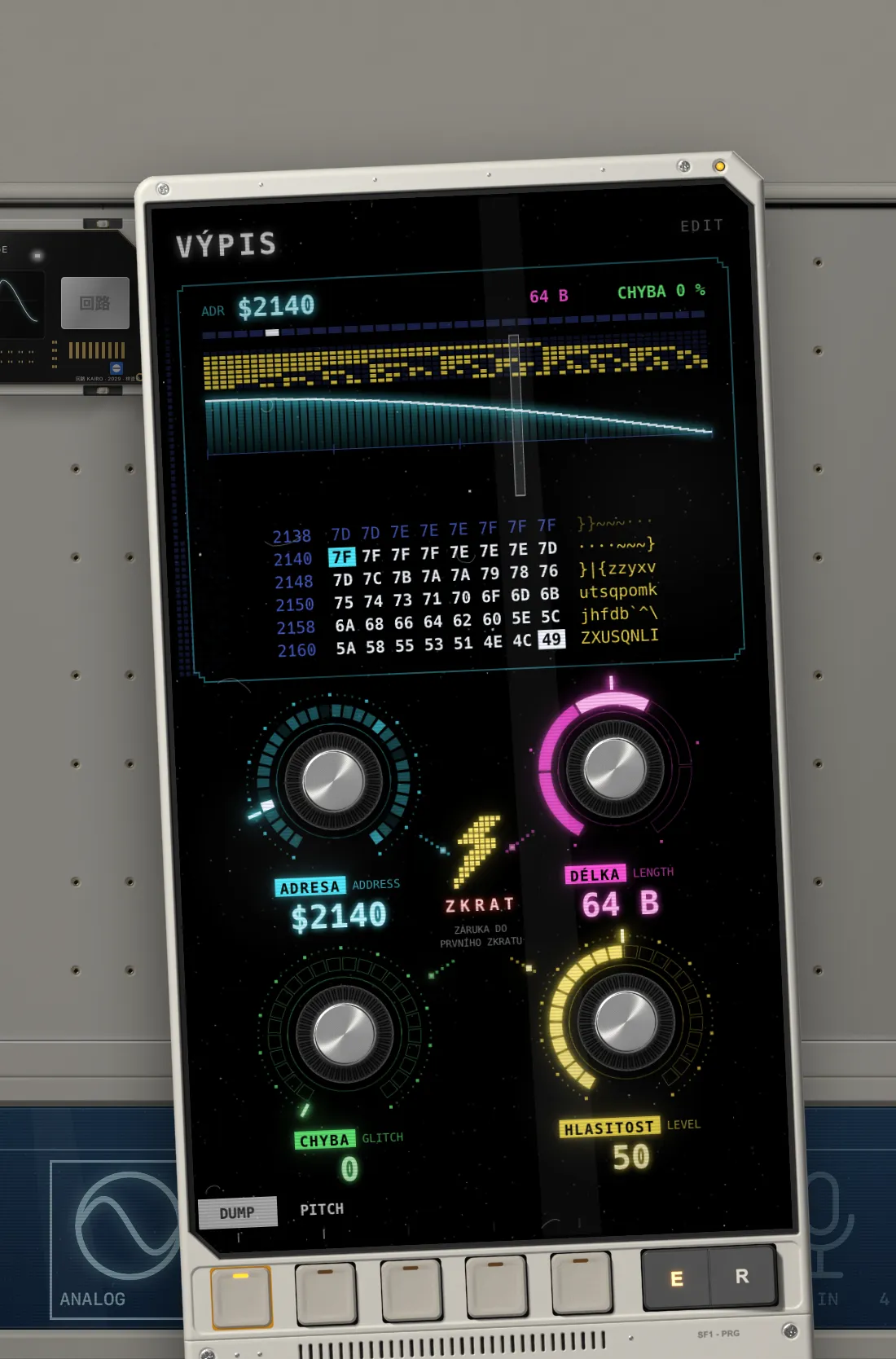
Program code is a buzz, a sine table is a sine, and empty memory is silence. The text is in there too. Somewhere around $1800 it says SF1 BIOS V0.7 and NO CARRIER, and you can play that.
RASTER
BERLIN · +49 30 2342 0815 · THE PICTURE IS THE INSTRUMENT
For years the world laughed at Germany for being too careful and too slow, too attached to its forms and standards while everyone else moved fast. Then the brakes came off everywhere. Everything was allowed and everything was available, and most of it turned out to be waste with a nice finish. Berlin had lived off stubborn, self-made people, and AI took over their work and most of the economy with it.
RASTER are the old ones, in their sixties. They grew up with Kraftwerk and were there for the first demo scene, and they watched it happen. They think it started with a phrase every German knows: sei mal nicht so genau, don't be so fussy. The small shrugs added up, until nothing could be made the same way twice.
So RASTER went back to the old working values and turned them into a cult. They draw everything to DIN, measure every gap and put a tolerance on every value. People laughed at that too, until it was the only thing in the city that still came out the same every time.
RASTER can't stand making a mistake. Everything they release is technically sound, so that nobody can ever hold anything against them. Somewhere in it there is one quiet joke, usually at someone else's expense.
Their programmer screens are DIN technical drawings. A little man sweeps the title line, because it's his week for Kehrwoche. The title block lists LIGNE's sheet as fehlerhaft, faulty.
Their board opens like a demo, with colour bars rolling down the screen and the greetings scrolling past. Their phone number ends in 0815, which is what Germans call a thing that is completely ordinary.
RASTER GRÜSST ALLE, DIE NOCH LÖTEN · KABELMAIER · ZKRAT · LIGNE · KAIRO
RASTER greets everyone who still solders.
Sieben Sägezähne, jeder gleitet in seinem eigenen Tempo zum Ton. Der Ton kommt nicht, er zieht auf.
Seven saws, each sliding to the note at its own pace: notes smear in instead of starting.
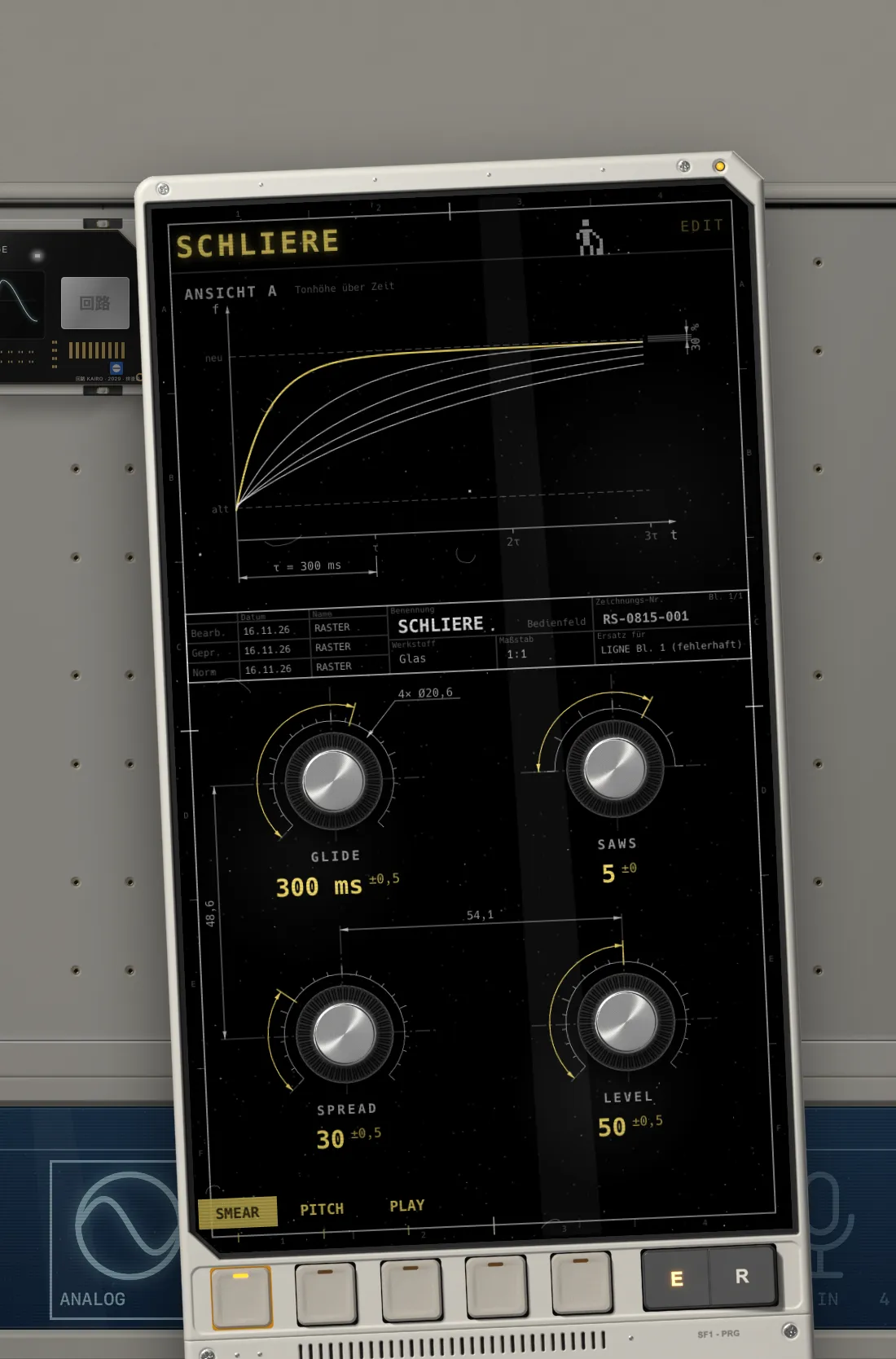
Seven saws per note, and each one slides to the next pitch at its own speed. A note smears in from the one before.
LIGNE
PARIS · +33 1 3615 0077 · VOICES DOWN THE LINE
LIGNE are the youngest, between sixteen and twenty. They started in the school blockades of autumn 2026. It began in Créteil, outside Paris, with pupils who were fed up with packed classrooms, missing teachers and buildings falling apart. Within weeks lycées all over France were barricaded, and most of the people arrested were minors.
Afterwards very little changed. Many of their friends gave up and disappeared into their phones, into feeds full of generated faces. A few didn't. They kept meeting, in a shut-down telephone exchange where the old copper lines still worked and a stack of Minitels was gathering dust. They had learned that you can't pull anyone out of the machine with the machine, so they went back to what it can't fake, a real voice on a real line.
Every member of LIGNE has a strong voice of their own, and none of them goes off alone. They speak on one line, by rules they all keep. They are rebels, they love France, and they're furious about nearly everything else. They refuse to print a word of English, so even the labels on the programmer are French when one of their modules is open.
Their number has 3615 in it, the prefix all of France once dialled to reach a service on the Minitel. Their board is a Minitel page, block mosaic along the top.
A combiné is a telephone handset, and the module sounds like one. Whatever you send through it comes out the far end of a bad line, and it has nothing to say until somebody speaks into PAROLE.
On the programmer, COMBINÉ is a poster: Marianne in her red cap shouting down the line, and across the knobs SOUS LES PAVÉS, LA LIGNE !
Their board carries one motto: La parole est à la ligne !
BIENVENUE SUR LIGNE. CHOISISSEZ PUIS ENVOI.
Welcome to LIGNE. Choose, then press ENVOI.
COMBINE.ROM · 8K · EFFECT
COMBINÉ
« Votre voix, mais au bout du fil. Huit bandes, de la friture et la tonalité. »
A vocoder down a phone line: eight bands, 300 to 3400 Hz, crackle and dial tone.
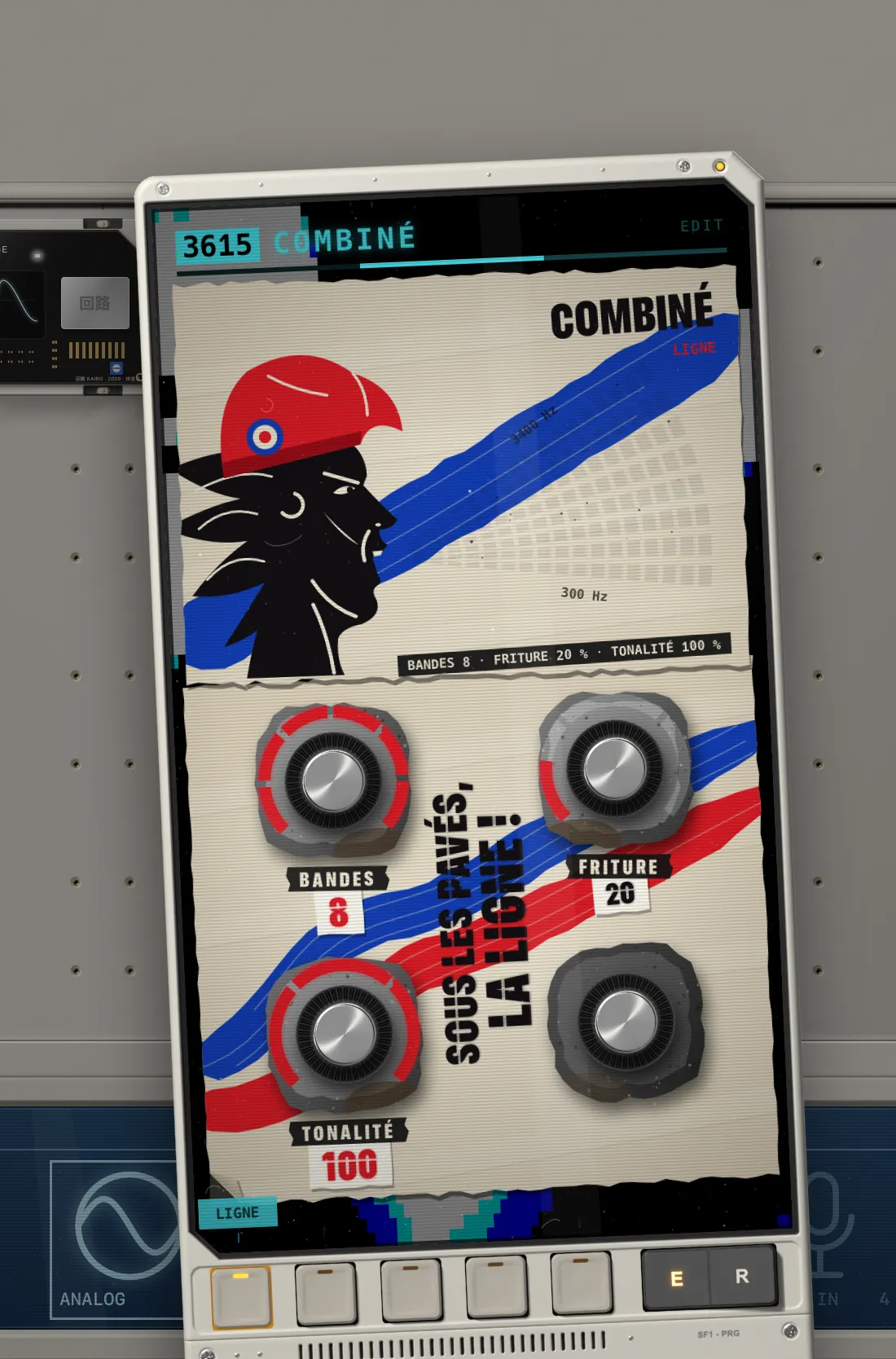
A vocoder squeezed into a phone line, with crackle and a dial tone. LIGNE soldered a second audio input onto it: PORTEUSE for the carrier, PAROLE for the voice.
回路 KAIRO
TOKYO · +81 3 5294 0404 · BENT TOY CHIPS
KAIRO are in their early twenties, the grandchildren of Tokyo's old family firms, some of them more than three hundred years old. For generations those firms made blades and lacquerware, and later transformers and radio parts. Each generation learned that the customer comes first and that a product is finished only when nothing more can be improved.
Their grandparents were the last to run the firms, and in their time the copies came. Machines turned out something that looked the same within a day, for less, and people were told perfection now takes a fraction of the time. One by one the firms closed over the last few years, and the grandparents, now in their eighties, tell the grandchildren how it used to be done.
KAIRO listened. They inherited the money, the tools and the habits. They still clean the workshop before they start, and they read their grandparents' notes to learn from them, not to speed them up. They buy the best parts there are and spend months on a single board. A copy can come close to their work, but it never gets all the way.
The name means circuit. KAIRO are circuit benders, and they overengineer everything, hardware and software, as far as it will go.
They started with what their creed says, bent toy chips: sound chips out of toy keyboards, rewired until they did things the toy never could. MAGE goes back to that. Phase distortion is how a line of Casio keyboards from the 1980s made its sounds.
Their board is an arcade screen at night, pink and cyan tube on dark blue with marquee bulbs chasing along the edge. Their work is loaded with symbols: neon, koi, and the Four Symbols, the creatures that guard the four directions, taken from the seals of the old firms. KAIRO put one on each encoder.
青龍
Azure Dragon
朱雀
Vermilion Bird
白虎
White Tiger
玄武
Black Tortoise
ようこそ、回路へ。曲げて、光らせて、鳴らそう。
Welcome to KAIRO. Bend it, light it up, make it sound.
MAGE.ROM · 4K · SOURCE
曲げ MAGE
位相を曲げる。正弦波がノコギリ波にも矩形波にもなる。
Bends the phase: one sine turns saw, square, pulse, or rings like a filter.
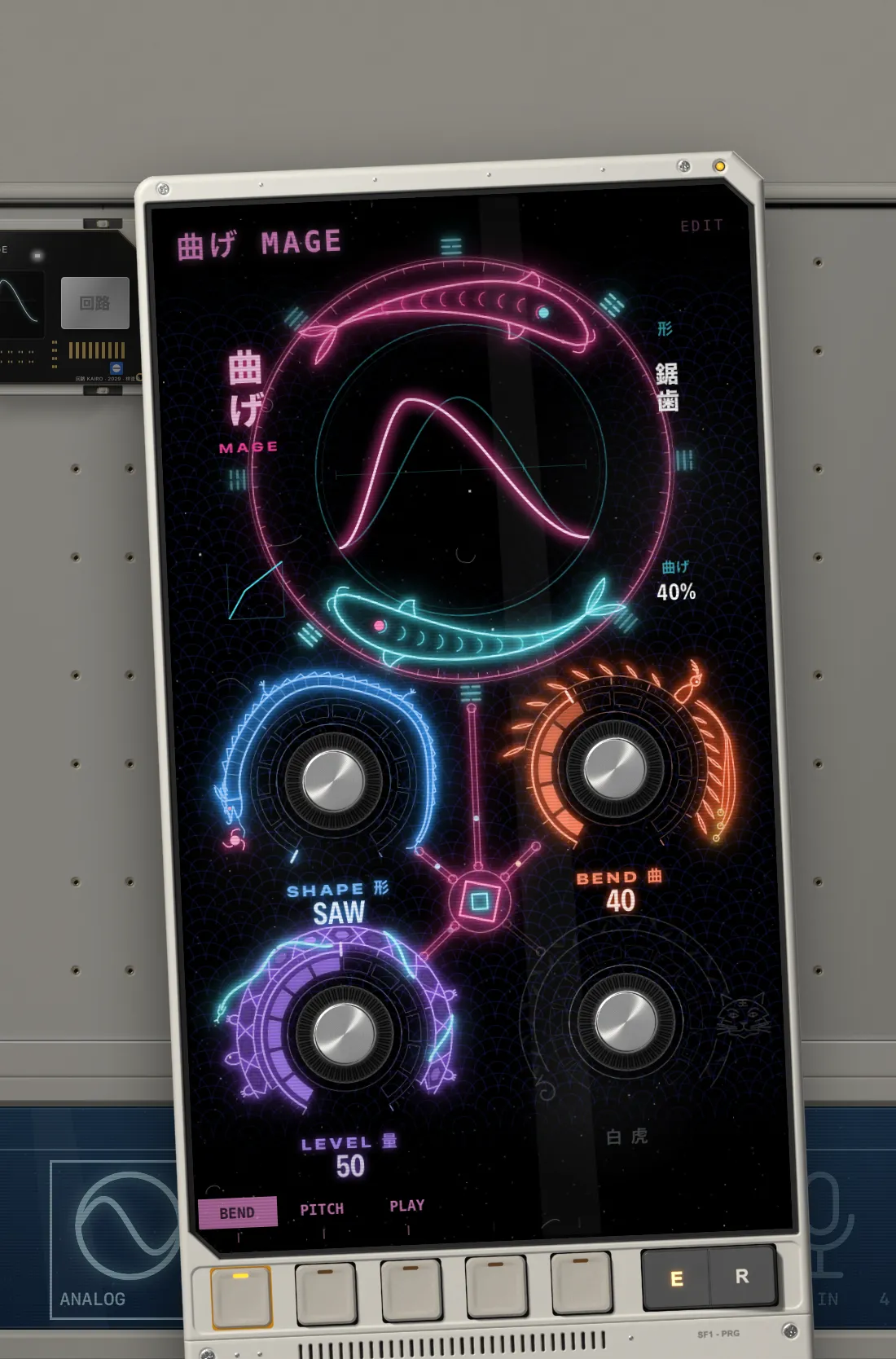
MAGE bends one sine into a saw, a square or a pulse, or makes it ring like a filter being swept.